
Futoshiki
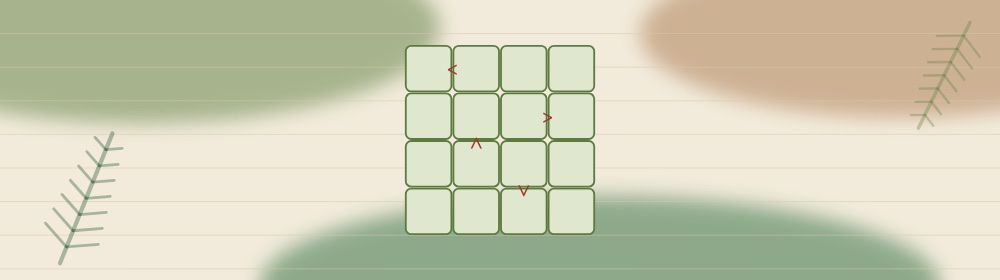
Place 1 through N once per row and per column while respecting the inequality signs: the point of the sign always aims at the smaller number.
One puzzle a day, the same for everyone
The day's Futoshiki grid, 5 × 5, is drawn from the date. It has one solution and only one, and it's the same for everyone today.
- The same grid for everyone, until midnight in your device's time zone.
- The solution is unique: no guessing is ever needed.
- The result you share is your time, never the solved grid.
- Completing a challenge, any of the four, extends your streak by one day.
The Free play / Daily challenge toggle sits at the very top of the board. The challenge never touches your free-play best times, and free play stays unlimited.
Five steps to your first grid
- Place 1 through N. Each row and each column contains every digit once, like a small sudoku with no boxes.
- Read the inequality signs. Between two neighboring cells, the point of the sign always aims at the smaller of the two numbers.
- Start from the givens. A few cells are already filled in to get your reasoning started.
- Cross-check the constraints. An inequality at the extremes (1 or N) often pins down a cell in one go.
- Check without guessing. The solution is unique: if you have to gamble, there's a clue you haven't read yet.
What you need to understand
An input for every way to play
Mouse and trackpad
Click a cell, then a digit on the keypad. Given cells can't be changed.
Touchscreen
Cells and keypad are sized for a thumb; nothing requires swiping.
Keyboard
The arrow keys move the selection, 1 to N enter a digit, 0 or Backspace clears. The inequality signs are announced in each cell's label.
Five things you won't work out on your own
- A chain of inequalities forces an order: three cells linked by “< <” can only be 1, 2, 3 in that order on a size-3 grid.
- A sign touching an edge often pins down an extreme value: nothing is smaller than 1 or larger than N.
- The point of the sign always aims at the smaller number: read it as an arrow pointing down toward the lower value.
- As in sudoku, eliminate by row and column first; the inequalities settle the remaining cases.
- The solution is unique: if you're torn between two digits, a clue somewhere else already decides between them.
Futoshiki, in detail
Place the digits 1 through N exactly once per row and per column, just like the rows and columns of a sudoku, but with no boxes.
Each “<” or “>” between two neighboring cells dictates which one is smaller. The point of the sign always aims at the smaller of the two numbers.
Yes. We start from a complete Latin square, keep just enough inequalities and givens to force uniqueness, and a solver verifies it.
No. Every grid can be fully deduced. If you're tempted to gamble, an inequality sign or a digit already placed hasn't been put to use yet.
4 × 4 and 5 × 5 in free play. The daily challenge is 5 × 5.
It's your fastest time, saved separately for each size.
The day's 5 × 5 grid is drawn from the date: the same one for everyone. The result you share is your time, never the solution.
No. Futoshiki (“inequality” in Japanese) is the name of a puzzle genre, not a brand. Our grids are generated by our own code.
Keep exploring the site
All four games play right on the page, with no account and no download.