
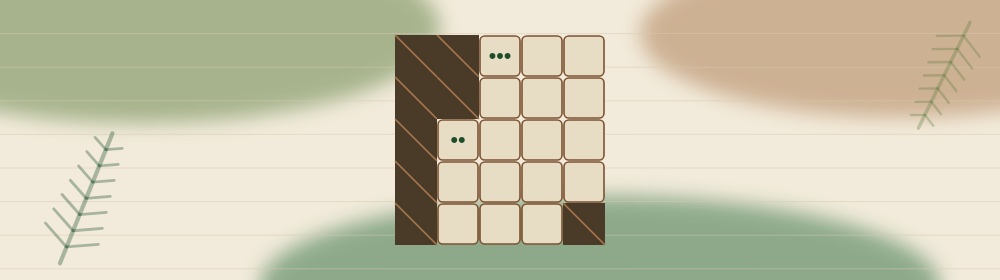
Kakuro
Fill the white cells with 1 through 9 so that each block reaches its sum, never repeating a digit within the same block. A few cells are already filled in to get you started.
One puzzle a day, the same for everyone
The day's Kakuro is built from the date: the same grid for everyone. It is generated and then verified — a single solution — and a few cells are filled in to get you off on the right foot.
- The same grid for everyone, until midnight in your device's time zone.
- Every grid is verified before it appears: one solution, and only one.
- The result you share is your time, never the digits in the grid.
- Completing a challenge, any of the four, extends your streak by one day.
The Free play / Daily challenge toggle sits at the very top of the board. The challenge never touches your free-play best times, and free play stays unlimited.
Five steps to your first grid
- Read the clues. Each black cell split by a diagonal gives the sum of the row to its right and the sum of the column below it.
- Spot the starter cells. A few digits are already in place, in a wood tint, to guarantee a single solution.
- Fill in 1 through 9. Select a white cell and type a digit, or use the keypad below the grid.
- Never the same digit twice. Within a block, a digit appears only once. A repeat is underlined in red.
- Close out every sum. Once all the cells in a block are filled, their total has to land exactly on the clue.
What you need to understand
An input for every way to play
Mouse and trackpad
Click a white cell to select it, then a digit on the keypad below the grid. “Clear” empties the cell.
Touchscreen
The cells and the number keypad stay big enough for a thumb, even on the 7 × 7 grid.
Keyboard
The arrow keys move the selection from white cell to white cell, 1 to 9 enter a digit, and Backspace clears. Each cell announces its position and its contents.
Five things you won't work out on your own
- Short blocks with extreme sums solve themselves: two cells adding to 3 are 1 and 2; two cells adding to 17 are 8 and 9.
- A cell belongs to both a row and a column: look for the digit that satisfies both sums at once.
- No block repeats a digit, so a two-cell block can never make an even sum out of two identical digits.
- The starter cells aren't there for decoration: they guarantee that only one compatible grid exists.
- If a sum seems impossible, work out the minimum and maximum reachable with distinct digits: they bracket the answer.
Kakuro, in detail
Each black cell split by a diagonal carries up to two numbers: the one at top right is the sum of the row of white cells to its right, and the one at bottom left is the sum of the column below it.
A Kakuro this size, with sums alone, sometimes allows several solutions. We reveal the smallest number of cells needed — usually two or three — so that only one remains. Those cells are shown in a wood tint.
Yes. A solver checks uniqueness before the grid is displayed: as long as it finds two solutions, another starter cell is added. The grid you see therefore has exactly one.
Never within the same block. A row or column of white cells contains all-different digits from 1 to 9. A repeat is underlined in red.
It's your fastest solve time, saved only if you accepted the “preferences” category.
Yes. The arrow keys move the selection from white cell to white cell, the 1 to 9 keys enter a digit, and Backspace clears. Each cell announces its position.
The day's Kakuro is built from the date: everyone gets the same one. The result you share is your time, never the digits.
The word “Kakuro” is a trademark of the Japanese publisher Nikoli in some countries; the cross-sums genre itself is free to use. Our grids are generated by our own code.
Keep exploring the site
All four games play right on the page, with no account and no download.